Sustainability Storytelling is now available in the U.K., Canada, and beyond
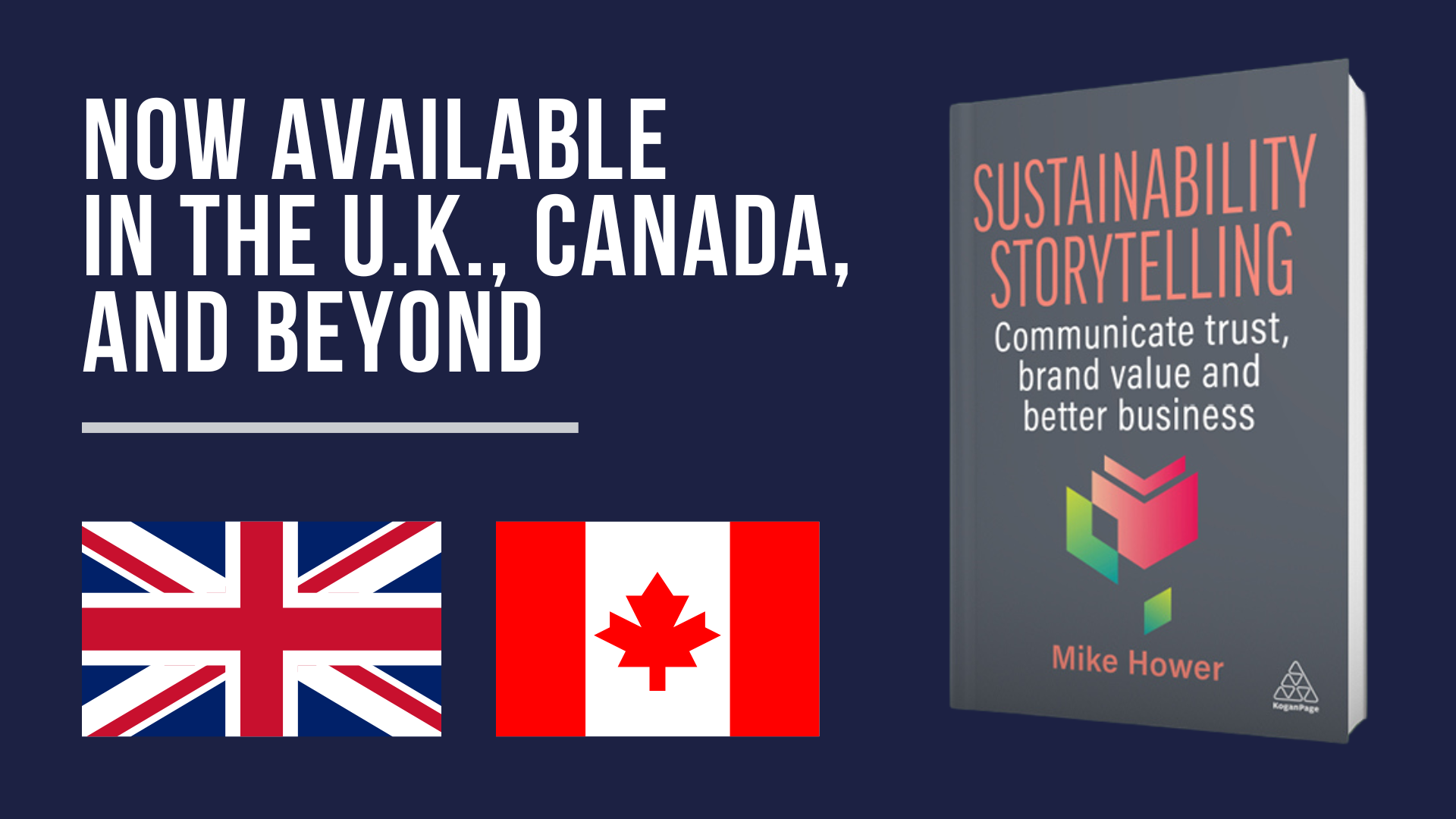
My first book, Sustainability Storytelling: Communicate Trust, Brand Value, and Better Business, is now available in print in the United Kingdom, Canada, and globally—with the exception of the United States, where it launches May 26.
Sorry, my fellow Americans, my publisher is British—not my call. Trust me, it’ll be worth the wait. Fortunately, the Kindle edition is available everywhere starting today.
The book is published by Kogan Page, an award-winning independent publisher whose sustainability titles include Solitaire Townsend’s Solutionists, Sandy Skees’ Purposeful Brands, and Matt Sekol’s ESG Mindset, among others. I’m honored to join the ranks of these published sustainability thinkers and doers.
About Sustainability Storytelling
I wrote Sustainability Storytelling to be the book that I wish existed when I first started out as a sustainability communicator.
At the time, many of the books I encountered were either too aspirational to be operational or too instructional to be inspirational. With Sustainability Storytelling, I tried to balance both.
Writing a book is an adventure that takes you to many unexpected places. After about a year of researching, interviewing, writing, and revising—and, admittedly, a tad bit of crying—I arrived at a place I feel good about. I’ve created something that I hope will serve as a useful resource for sustainability communicators around the world for years to come.
Sustainability Storytelling is both a practical guide and clarion call for sustainability communicators across industries and roles—including sustainability, ESG, climate, communications, marketing, and legal professionals—working to translate sustainable business strategy into narratives that inform, inspire, and activate stakeholders.
All of this while mitigating greenwashing risks and creating confident and courageous communication that counters the current greenhushing epidemic
Infused into the book are my nearly two decades of experience on both sides of the podium—as a journalist for media outlets like GreenBiz, Sustainable Brands, and Triple Pundit, and a sustainability communicator for leading global companies like The North Face, HP, and Mars. Because I certainly don’t have all the answers, I also brought into the book insights from over a dozen sustainability leaders, including GreenBiz co-founder Joel Makower, who wrote the foreword, Dave Stangis of Apollo Global Management, Dan Strechay of PepsiCo, Susan Jackson of BASF, Nate Pepper of Veolia, Aman Singh of Kenvue, Josh Wiener of MetLife, Alison Taylor and Tensie Whelan of NYU Stern School of Business, Sophia Mendelsohn of SAP, Ellen Weinreb of Weinreb Group, Ellen Jackowski of Mastercard, and even Denis Hayes, the first Earth Day coordinator.
I structured the book to be a self-contained sustainability communication masterclass, with chapters spanning the foundations of sustainability storytelling (including the history of sustainable business and corporate communication, and the business case for sustainability) to developing and delivering effective sustainability narratives. Each chapter features an “Expert Insights” Q&A with leading sustainability practitioners at companies across industries.
Sustainability Storytelling also unveils a new actionable framework for sustainability communication called The Four C’s of Effective Sustainability Storytelling:
Context: Understanding the cultural, industry, and reputational forces that shape how your message lands before you say a word.
Compelling: Cutting through the noise to make sustainability tangible, memorable, and worth acting on.
Credible: Aligning what you say with what you actually do, so your sustainability story holds up under scrutiny.
Compliant: Protecting your organization from greenwashing risk without sacrificing the impact of your story.
“Effective sustainability communication is not about spin or about selling ideas. It’s about helping people see themselves in the story,” Joel Makower writes in the foreword for Sustainability Storytelling. “It’s about making the abstract concrete, the distant immediate, and the complex relatable. It’s about showing not just what a company is doing, but why it matters to its various publics.”
Why this matters for U.K. and Canadian readers
In her endorsement for Sustainability Storytelling, Sally Uren, Executive Director, Forum for the Future, a leading international sustainability nonprofit founded in the U.K., said:
“Every single sustainability challenge we face today requires system change. System change in turn doesn’t just require policy change, collaboration and new flows of capital. System change requires shifts in narratives and shifts in mindsets. These are the deepest levers for change, made possible by storytelling. This is why this book, right now, is a timely and critical contribution to creating a better future for us all.”
For readers in the U.K. and Canada, that urgency is particularly acute. Both the U.K. and Canada face their own unique sustainability communication challenges—and both countries have raised the regulatory bar significantly in recent years.
In the U.K., the Competition and Markets Authority’s Green Claims Code requires sustainability claims to be truthful, substantiated with evidence, and consider full product lifecycles. Regulators have proven willing to act against high-profile violators—in 2024, Virgin Atlantic was ruled against for its “100 percent sustainable aviation fuel” claims, which regulators found implied zero environmental impact. Any business targeting U.K. consumers must comply, regardless of where it operates.
Canada has gone even further. Strengthened by 2024’s Bill C-59, Canada’s Competition Act now creates one of the world’s most aggressive anti-greenwashing frameworks. The key innovation: companies must have evidence ready before making environmental claims, not after being challenged. Keurig Canada learned this the hard way, paying $3 million for misleading claims about K-Cup recyclability that didn’t reflect actual infrastructure capabilities.
Yet even as regulations tighten, consumer demand for credible sustainability communication has never been stronger. PwC research shows that 40 percent of customers stop purchasing from companies they don’t trust, while 46 percent increase spending with companies they do. And with 69 percent of people globally worried that business leaders deliberately mislead them—an 11-point surge since 2021, according to the 2025 Edelman Trust Barometer—the stakes for getting sustainability communication right have never been higher.
Sustainability needs better stories. I hope this book helps you tell them.
Grab your print copy with this special discount
The print edition of Sustainability Storytelling is available now in the U.K., Canada, and most of the world—but Americans can still order today and receive their copy after May 26. Those attending one of the in-person Sustainability Storytelling LIVE events will get their print copies before everyone else in the U.S.
If you order directly from Kogan Page, you can use the code SUSTAINABILITYSTORY25 at checkout to receive 25 percent off. You also can order on Amazon sans the discount if that’s more convenient. Again, the Kindle edition is available globally starting today.
If you’ve already gotten your hands on an early copy, I’d be incredibly grateful for an Amazon review—even a sentence or two makes a real difference for a first-time author.