Context: The silent force behind every sustainability story

This post originally appeared in The Sustainability Story Substack. Learn more and subscribe.
Sustainability storytelling doesn't happen in a vacuum. Sustainability messages navigate a complex web of factors that determines how they'll land with audiences. This context—the first C in the Four C's of Effective Sustainability Storytelling—determines whether your message resonates or falls flat before you've even said a word.
For global companies communicating sustainability across cultures, this is particularly problematic. The same message that builds trust in one market can spark backlash in another. And in increasingly polarized places like the United States, many sustainability stories have become part of the culture wars.
Three forces shape context:
Cultural norms and values
Industry perception and reputation
Brand reputation and trust
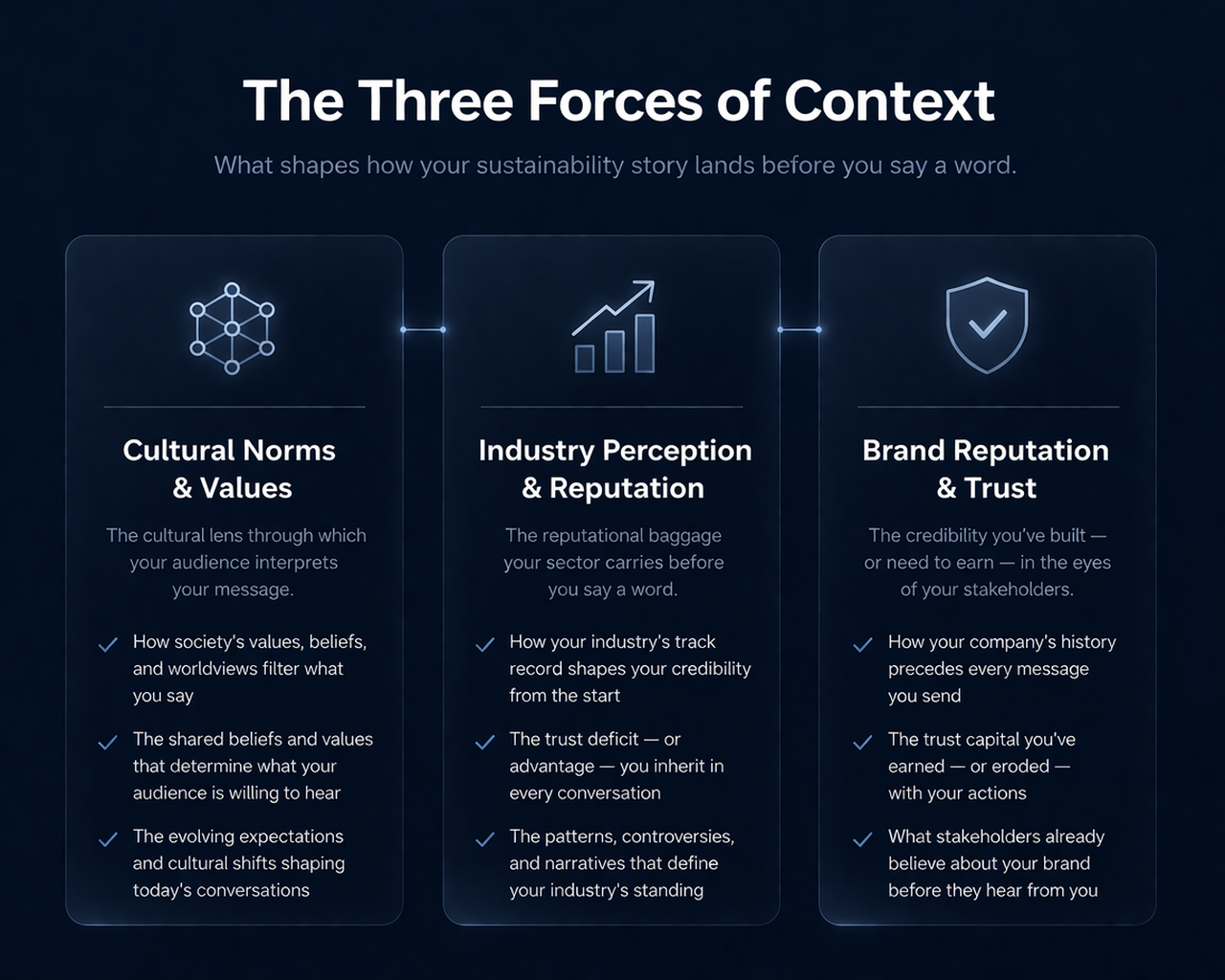
While you can't fully control these contextual forces, your company can learn to anticipate them and adapt accordingly. Let's explore each of these now.
Navigating cultural nuance
Sustainability means different things in different cultural contexts. If we go by the Corporate Governance Institute's definition of sustainability as "the long-term viability of a company's operations accounting for environmental, social, and economic impacts," this makes translating sustainability messages across cultures particularly challenging.
Communicators at global organizations are already familiar with the practice of glocalization—thinking globally while acting locally. This is hard enough when communicating products and services, and is doubly so when communicating sensitive sustainability topics, particularly social ones. One-size-fits-all messaging across geographies consistently fails.
Communicating about a diversity initiative in San Francisco is going to land differently than in rural Alabama. Likewise, LGBTQ+ inclusion messaging that resonates with progressive urban consumers in Western markets can become a flashpoint elsewhere. When Nike launched its BETRUE rainbow collection in Russia, a politician attempted to have it banned under the country's "gay propaganda" law. Nike stood firm, reaffirming its support for diversity while allowing local stores to decide which products to carry. The campaign to ban it fizzled. Nike held its ground—a reminder that understanding context isn't the same as surrendering to it. Sometimes you communicate knowing full well the message won't land everywhere. The goal isn't universal resonance. It's knowing the difference between a message that needs to be adapted and a value that must be defended.
So how do you know when to adapt and when to hold firm? The answer lies in the distinction between cultural differences and universal human rights. Cultural relativism argues that moral standards are defined by culture—that there's no universal right or wrong. But taken too far, that logic would prevent companies from ever taking a stand against child labor, forced labor, or unsafe working conditions simply because they're normalized somewhere. The Universal Declaration of Human Rights—adopted by 48 nations in 1948 with none voting against—offers a practical anchor. It helps companies draw a clear line: adapt your framing to cultural context, but never compromise on principles that represent our shared humanity.
The question isn't “are we imposing our values?” It's "are we upholding universal human rights?" That distinction is what gives companies the moral clarity to communicate consistently across cultures—and the courage to hold their ground when they need to.
With the world's largest companies hailing from the U.S. and EU, corporate sustainability is heavily influenced by Western values. That's a blind spot worth examining. What reads as responsible and progressive in Stockholm or San Francisco can feel like cultural imposition in markets with different histories, values, and political realities.
The lesson isn't to water down your commitments—but to understand the context you're communicating into and adapt your framing accordingly.
Industry perception and reputation
Every industry carries reputational baggage that precedes your sustainability messages. Before a sustainability communicator does anything, their audience has already formed a view—shaped by the sector's track record, past controversies, and broader public perception.
Some industries start with a credibility deficit. Fossil fuel companies (obviously), fast fashion brands, and chemical manufacturers face deep skepticism that no single campaign can undo. Others start benefiting from a halo effect—where industries are perceived as being inherently “good.” Tech companies, for example, have long been seen as innovative and forward-thinking—yet are now facing growing scrutiny over topics like AI ethics and safety, energy consumption, labor practices, and supply chains.
Research on the CSR halo effect shows that companies that communicate sustainability more effectively are often perceived as more sustainable—regardless of actual performance. That cuts both ways. It means communication matters more than many sustainability teams want to admit. But it also means the gap between perception and performance is a reputational risk. Companies that get ahead of their skis on sustainability claims tend to fall harder than those that stayed quiet—but neither approach builds the long-term trust that stakeholders actually reward.
My advice is to map your perception-performance gap honestly. If your sustainability work exceeds public perception, the answer is better storytelling. If perception is running ahead of performance, you risk disappointing stakeholders when the gap between your narrative and your actual performance becomes impossible to ignore.
Brand reputation and trust
Your brand's history walks into every conversation before you do.
Brand reputation has an outsized effect on whether your sustainability messaging is received with skepticism, acceptance, or something in between. A strong sustainability reputation creates a halo that cushions criticism and amplifies good news. A weak one creates a horn effect that magnifies every misstep. Consider PG&E, which generates 95 percent GHG-free electricity—a genuinely impressive achievement—yet ranks among the lowest U.S. utilities in customer trust. Its wildfire record and investor-owned status overshadow its clean energy performance entirely. The sustainability story is real—but the context makes it tough to tell.
The inverse is also true. Companies with strong reputations get more benefit of the doubt—more room to acknowledge setbacks, more credibility when they make ambitious commitments, more goodwill when things don't go as planned.
Before you craft a single message, take stock of where your brand actually stands. Not where you think it stands, and not where your last survey said it stood—where stakeholders, critics, and the broader public perceive it to be.
That's the starting point for every sustainability story you'll tell.
Context as a diagnostic
Understanding context doesn't mean letting it paralyze you. In an era when many companies are greenhushing—scrubbing language, softening commitments, staying silent even when they have something worth saying—it's tempting to use context as a reason to say nothing at all.
That's the wrong lesson. Context tells you where to start, what language to use, which audiences to prioritize, and what risks to anticipate. Two companies with identical sustainability performance can get completely different reactions from the same audience—because one understood the context it was communicating into and one didn't. That gap is where sustainability communicators earn their paycheck.
Understanding context is foundational—but it's only the first C. In the next piece in this series, I'll dive into the second: Compelling—and why making stakeholders care about your sustainability story has less to do with clever copywriting than it does with understanding how people actually make decisions.
The Four C's of Effective Sustainability Storytelling is the framework at the heart of Sustainability Storytelling: Communicate Trust, Brand Value and Better Business—where I dedicate a full chapter to each C, including a deeper dive into context. Coming May 2026, available for pre-order now.