Finding my purpose as a sustainability communicator
Building a career in sustainability rarely looks like a straight line.
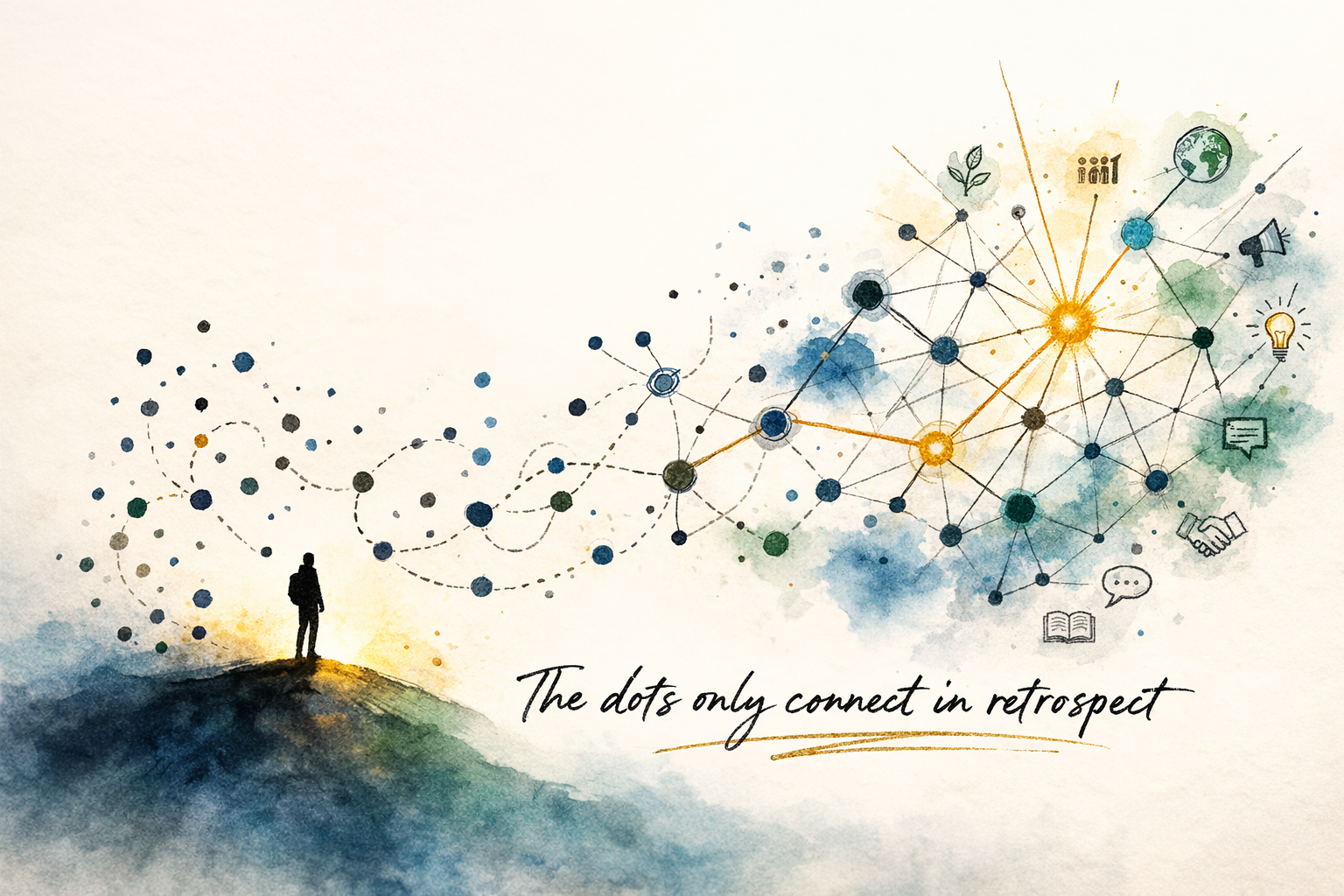
Rather, it resembles a page filled with dots. Each dot represents a professional or personal experience that might feel random at the time but, in retrospect, connects—and ultimately helps you converge on what you seek to achieve.
For nearly twenty years, I was focused on placing the next career dot without knowing what the final picture would look like. Some dots were intentional. Others felt accidental, or even like mistakes. Yet all of them helped me become the sustainability professional I am today.
A colleague once told me I'm stubborn about my goals but flexible about my methods. Looking back, it's the most accurate description of how I've built my career in corporate sustainability. I'm clear about my purpose—even when I'm not always certain about the path forward.
In sustainability careers especially, that balance isn't optional. There are few linear pathways and almost no established playbooks. If you don't adapt, you eventually break. But adaptation without a clear purpose may lead you astray.
The Japanese call that sense of purpose ikigai—your reason for being. In practical terms, it's where what you care about, what you're good at, what the world needs, and what you can be paid for overlap. Paulo Coelho calls it your Personal Legend: the pull toward the work you were meant to do, even as fear, obligation, and comfort conspire to keep you from it.
For me, sustainability communication is a calling more than a career. I'll be advancing the cause of sustainability storytelling until my last breath. What matters to me has never been titles, accolades, or money on its own—but whether the work actually made a difference. And as I prepare to become a father in just a couple of months, I find myself thinking less about my own career arc and more about the world my child will inherit. One day, I want my daughter to be able to look back on my life and know that I was one of the helpers in a time when so many were just looking out for themselves.
This week marks three years since I founded Hower Impact—and the anniversary got me reflecting on the journey that led here. Today, I'm sharing the story of how I found my purpose as a sustainability communicator—and what I learned along the way about placing those dots, trusting the pull of purpose, and building a career without needing to see the full picture.
As with all journeys, mine began with finding the courage to take that first step into the great unknown—quite literally by escaping a corporate cubicle in San Francisco.
The great escape from a corporate cubicle
I graduated from college in 2009 during the worst economic crisis since the Great Depression with a degree in Political Science and History, a love of writing, and no idea what I wanted to do with my life. Corporate sustainability wasn't even on my radar.
A friend suggested I look into public relations. I Googled it, said "why not," and landed an unpaid internship at a San Francisco PR firm. To actually help pay my bills, I'd leave the office at noon, take BART home, and spend the afternoon babysitting elementary school kids—playing Nintendo Wii and kicking a soccer ball around. Not exactly the zenith of my career aspirations. But I showed up, learned, and after a month the PR firm hired me full time.
I spent my days cold-pitching reporters about funding rounds and tech releases, facing slammed phones, and curt rejections for stories I couldn't have cared less about. I once pitched Joel Makower at GreenBiz (now Trellis)—who had no idea who I was at the time and definitely doesn’t remember. Yet years later, he'd become one of my mentors and write the Foreword to Sustainability Storytelling, my first book.
A couple of clients genuinely intrigued me though: a solar company, and a software firm helping data centers run more efficiently. The idea of business solving environmental problems profitably was something I could get behind.
But, mostly, I sat in my cubicle wondering if this was it: nine-to-five for forty years, retire, then die. I’d done everything right—studied hard, graduated on time, found a job—yet it felt hollow. I knew there had to be more to life than climbing the corporate ladder. So, between media pitches and many unnecessary meetings, I started planning my escape.
I considered graduate school, the Peace Corps, and even the Navy's Officer Candidate School. Then one Friday evening, at a friend of a friend's place, I noticed a photo on the wall: a guy posing with schoolchildren somewhere tropical. Turned out he'd spent a year teaching in the Marshall Islands through a volunteer program called WorldTeach, a program run out of Harvard University. That night, I went home and devoured WorldTeach’s website and was ultimately intrigued by its Colombia program. I applied, got in a few weeks later, and was assigned to spend a year teaching in a poor neighborhood of Bogotá, Colombia.
I'm not sure who I was more nervous to tell—my parents or my manager. My mom cried, mostly out of fear that Colombia was too dangerous for a tall gringo from California. My dad just said: "No matter where you go, you'll always have a home base here."
On my last day, the weight of my decision nearly broke me. I seriously considered walking back to HR and asking for my job back. What if this destroys my career? What if I fall behind and never catch up?
During my final meeting with my manager, she looked at me and said: "If you feel that you need to do this, you need to do this. Now is the time in your life to take risks."
At 22 years old, I knew she was right. To help the world, I first needed to know it.
I walked out the door and never looked back.
The ‘best, worst, and greatest year of my life’
On New Year's Day 2011, I arrived in Bogotá with an abundance of good intentions and a dearth of international experience. After a few weeks of training with other volunteers, I moved in with a host family and began supporting elementary and high school teachers with English education in one of the city's low-income barrios.
Standing well over six feet tall made me the tallest person the children had ever seen, and I was an instant celebrity. El Gringo Alto (“The Tall Gringo”) they'd call me affectionately. Crammed into small collectivo buses each morning, I commuted to work feeling like I could singlehandedly save the world. My naivete was palpable.
I later learned that my volunteer program was part of a corporate social responsibility initiative run by IBM, which supplied funding, computers, and software intended to help the children learn. Yes, before I was helping companies write sustainability reports, I was part of one.
Even today, that experience shapes how I approach sustainability communication. These are stories of real people living their lives—not just case studies in a glossy PDF meant to appease investors—and they deserve our respect.
But my time in Colombia wasn't all positive. I tell people it was "the best, worst, and greatest year of my life." A year is a long time to be thousands of miles from home where you barely speak the language, and I'll forever carry empathy for immigrants and expats who know what it feels like to not belong.
I also learned that a year wasn't enough time to undo complex socioeconomic inequality. My students were making little noticeable progress despite IBM's technology—and what the company later claimed in its sustainability report. I narrowly escaped a mugging after being surrounded by teenagers with knives outside the school. Halfway through the year, my host mother experienced a mental health crisis and I had to find somewhere else to live.
As I always do, I turned to writing as a coping mechanism. My blog, The Tall Gringo, earned a cult following in South American expat and travel circles. There were moments I seriously considered quitting. I even drafted a resignation letter—but never sent it. I felt as rudderless as I had back in San Francisco.
But that would all change in my final weeks in Latin America.
Traveling to Panama during one of the fall festivos, I visited the San Blas Archipelago—known as Guna Yala by the indigenous Guna people who have called it home for centuries. White beaches, tall palms, locals fishing from dugout canoes and selling handmade molas at the market. Paradise, in every sense of the word.
During a tour of the capital island, my local guide told me that rising seas posed an existential threat to the Guna people, and that they would likely need to evacuate to the mainland in a matter of years. I’d never thought about climate change like that before. Not as something happening to real people, in a real place, right now. Until that moment, climate change had been an abstraction to me—a headline, a political argument, a problem for future generations. On that island, it was none of those things. It was someone's home, and it was disappearing because of me and millions of others in the Global North who’d never once had to think about the consequences of how we lived.
I had found my purpose: dedicating my life to building a more sustainable world by addressing problems like climate change. But while I now knew the why, I still didn’t know the what or how.
Discovering corporate sustainability
In January 2012, I returned to California utterly changed. Walking the streets of San Francisco's Financial District, sitting at happy hours with friends complaining about their corporate jobs, I felt like a foreigner in my own land. There was no going back.
I spotted a job posting for an organization called Sustainable Brands, looking for a marketing coordinator to help promote its flagship conference. I had no idea what a "sustainable brand" was—but it sounded like exactly what I was looking for. I applied, interviewed, and got the job.
I'll admit: I initially found the concept of "corporate sustainability" offensive. How could a profit-driven organization actually care about purpose? I assumed everything was greenwashing. And while in 2012 much of it certainly was, the more I learned, the more I was hooked.
At my first Sustainable Brands Conference in San Diego, I felt like I'd finally found my people. The idea that business could be a force for good took hold in my brain and never let go—though I held onto my skepticism, which would later serve me well as both a journalist and a sustainability communicator.
I became singularly focused on breaking into the field. But sustainability was still a fledgling profession with few obvious roles for communicators, so again I turned to writing. Sustainable Brands hired me to cover corporate sustainability news and innovations. That led to writing for Triple Pundit. I was waking up at 6 am to file stories before heading to my day job at a Silicon Valley startup—technically working in sustainability as a freelance journalist, but I didn't yet feel like I was truly part of it.
By 2014, an old case of “Potomac Fever” resurfaced. I'd first contracted it during a Capitol Hill internship in college, and now—having applied to graduate school on a whim—I learned I'd been offered a full merit scholarship to George Washington University's School of Media and Public Affairs. I still believed that private sector action alone would never be enough, that sound public policy was essential. Washington, D.C. seemed like the right place to test that theory and gain some experience.
I left San Francisco to spend two years studying under some of the country's leading strategic communication experts, including former CNN White House Bureau Chief Frank Sesno, who became another mentor. I kept writing for Sustainable Brands and Triple Pundit throughout.
My sights were set on writing for GreenBiz, but I had no connections there. Then a GreenBiz executive retweeted one of my Triple Pundit pieces, and I messaged him immediately. He arranged a meeting with Joel Makower.
We met in Dupont Circle, not far from where he'd launched GreenBiz two decades earlier as a newsletter. I kept my cool, told him I wanted to advance sustainability through the power of story, and he said: "Why don't you write for us?"
Writing for GreenBiz elevated my profile in unexpected ways, as I got access to C-suite executives and sustainability leaders at major global companies. The Paris Agreement in 2015 felt like a genuine turning point, a moment when the world finally seemed to be moving in the same direction. Companies were racing to set ambitious sustainability goals. For the first time, it felt like we had the bad guys on the backfoot.
When I finished graduate school in 2016, I faced a choice: stay in D.C. and pursue public policy, or return to San Francisco and go deeper into corporate sustainability. I chose the latter. I still believed in the importance of policy—but I felt I could do more good from inside the private sector. And after years of reporting on sustainability stories, I was ready to start shaping them.
From journalist to sustainability consultant
I found that opportunity when I landed a job at Edelman—one of the world's largest and most prestigious PR and communications agencies—on its Business + Social Purpose team, essentially a sustainability communication boutique helping Fortune 500 companies tell their sustainability stories.
Edelman was brutal. The hours were long, the expectations impossibly high, and the margin for error microscopic. I'd get reprimanded for missing periods in client emails. As someone who had spent years thinking freely as a journalist, I found that at Edelman your opinions were only worth as much as your title—and mine wasn't worth much at first with my mid-level title. The funny thing was, I'd receive media pitches at my Edelman email from people wanting me to cover their clients' sustainability stories—nobody seemed to be able to put their finger on just exactly who I was.
Edelman broke me—and then rebuilt me as a sustainability communication consultant with an almost obsessive attention to detail and project management skills that still serve me today. But despite the challenging work culture, Edelman gave me the opportunity to work on some amazing and impactful projects with clients like The North Face’s “Walls Are Meant for Climbing” campaign, HP’s sustainability thought leadership, Kashi’s regenerative agriculture efforts, and others.
But I'd seen what happens to people who stay at large agencies too long. I didn't want to lose my creative spark or independent spirit, so I left to join a small climate tech startup focused on energy efficiency in commercial buildings. I wanted to get back to what had first sparked my interest in purpose-driven business: climate tech.
It didn't last. The startup turned out to be more smoke and mirrors than substance, and I moved on.
At that point I'd been thinking seriously about starting my own business—but kept talking myself out of it. The founder of a small sustainability reporting agency made a compelling case for why I should help him grow his business instead. So, I wrote my own job description: Head of Client Engagement, bringing in new clients while also doing the work. It felt like a reasonable compromise.
It turned out to be more than that. My LinkedIn following was growing steadily. I kept writing for GreenBiz. Then the pandemic hit, and everything changed. Larry Fink's 2020 letter to CEOs sparked what I think of as the ESG Golden Age—a rush of corporate investment in sustainability strategy and reporting driven by investor pressure. That wave met the network I'd spent a decade building, and I nearly doubled the agency's revenue in three years.
But by the summer of 2022, I'd hit a wall. I'd achieved everything I'd set out to do—and was being boxed into a sales role I resented. I realized that clients were coming to me because of my own credibility and relationships, not because of the agency's name.
During a solo trip to the Smoky Mountains of North Carolina, I spent a few days disconnected from my laptop, hiking and sleeping in a yurt and reflecting on what would come next. On a white legal pad, I sketched out ideas for striking out on my own. At the time, 'Hower Impact' was the name of my blog, but I realized it could become so much more. I thought about providing sustainability career coaching and learning resources, while continuing to consult with major companies.
But when I got back to work, I fell back into the safety of a regular paycheck and deferred that dream a little longer.
That is, until I nearly lost my father—and learned what "life's too short" actually means.
A family health crisis changes everything
In the fall of 2022, I learned my dad had cancer—multiple myeloma, an incurable but treatable blood disease. His health deteriorated fast. Despite having good insurance, it took weeks for treatment to begin due to bureaucratic hurdles, and he started experiencing unbearable pain. My mom and I eventually took him to the ER, where doctors diagnosed kidney failure and were able to treat it.
Over the next few months, there were several ups and downs and my dad was in and out of the hospital—we nearly had to spend Christmas there. By the end of December 2022, he seemed to have stabilized, and so I felt comfortable leaving to have a small New Year’s Party with friends and my girlfriend (now wife) at the home I own in Sacramento. The party was a welcome respite from a stressful couple of months.
But on New Year’s Day 2023, I received a frantic call from my mom saying that my dad had collapsed with seizures, was being taken to the ER, and that I needed to drop everything and get there ASAP. Jumping into my car, I drove two hours back to the Bay Area and arrived at the hospital just minutes before the doctors were to cart him into emergency surgery. My mom stood solemnly outside the room where my dad lay as doctors and nurses buzzed about him running tests. My brothers and their partners soon arrived.
A doctor came out and told us that my dad had experienced an aortic aneurysm, had lost a lot of blood, that the outlook wasn’t good, and that we should go in and say our goodbyes. After my brothers had gone in and talked to him, I stepped into the room. My dad was ghostly white after losing so much blood and he was acting delirious. Call it stubbornness, call it denial—I couldn’t bring myself to say goodbye.
“You’re going to get through this, dad,” I said. “I’ll see you again real soon.” I told him I loved him and left the room.
After they carted my dad away, I sat with my family in a waiting room awaiting an update. My girlfriend of only three months came and sat with me (that was the moment I knew she’d be my wife) as I cried and saw a lifetime of memories of my dad flash through my mind: reading to me as a child, teaching me how to change a tire, making me feel safe as we camped in the Tahoe wilderness, and teaching me the value of hard work and the pride in fixing things that are broken. He had been an auto mechanic and instilled in me a blue collar work ethic that has always served me well in a white collar world.
After the longest night of my life, the surgeon came in and told us that my dad was alive and that the surgery had been successful. They had given him 12 units of blood—about the total amount that’s in a human body. While we weren’t out of the woods yet, the imminent danger had passed. As they had done an open surgery to re-route his blood flow, they put him in a medically induced coma.
The next day, I visited my dad in the ICU. The color had returned to his face, though he was now intubated. Going through such a traumatic loss of blood, we had no idea if he’d ever awaken and even if he did, if he’d still be himself. I sat next to him reading out loud from a book about cars to pass the time. I couldn’t bring myself to leave him alone overnight, and so sat in an uncomfortable hospital chair and caught snatches of sleep.
The morning came and the doctors told us things were progressing well enough to wake him up that day. They removed the tube, took him off the sedatives, and he opened his eyes. When the first words out of his mouth were a joke, we knew he was going to be okay. Thankfully, he had no memory of what had transpired over the past 48 hours.
As my dad recovered, they eventually brought him out of the ICU and into the Step-Down Unit. I’d sit with him for hours, talking to him when he was awake and working on my Hower Impact business plans when he wasn’t.
“What are you working on?” He asked me one day as I sat with my laptop on my lap when I thought he was sleeping.
“Just plans for starting my own business,” I said. “I think it’s time I try something like that.”
“I think you should do it, you’d be really good at it,” my dad said. “And no matter what happens, you have a home base here.”
It was the same thing he’d said when I left for Colombia. No matter how wild the leap, he (and my mom, too) would always be there to back me up.
I’d seen just how fragile and uncertain life is. In an instant, it can all be gone. Having just faced one of the most frightening experiences of my life, starting my own business no longer felt so scary.
Later that day, I put in my notice at the agency.
Starting Hower Impact
This week, Hower Impact turns three.
My dad made it through the aortic aneurysm—something that should have killed him—and then fought through his multiple myeloma treatment and got his cancer under control. While it isn't curable, it can be managed to the point where you can live a relatively normal life for many years. Three years later, he's doing well, and every moment I spend with him feels like a Christmas bonus.
And in a few months, I'll welcome my own daughter into the world. I hope to be for her what my parents have always been for me—a home base. Someone who makes her feel supported to take the leaps of faith that make life rich.
The past 36 months running my own sustainability communication and reporting consultancy have been among the most fulfilling of my career. I've supported sustainability leaders like Mars as a fractional sustainability communicator, helping develop and deliver a Net Zero Roadmap. I've helped countless other companies sharpen their sustainability narrative and reporting. And being independent has allowed me to say the things everyone else is thinking but too afraid to say—on LinkedIn, at conferences, and in this Substack. It has also given me the freedom to write a book I couldn't have written answering to someone else.
Despite the sustainability downturn, demand for Hower Impact's services has held strong. Many clients come to me after being burned by the inefficiencies of the traditional agency model, preferring the intimacy and quality control that comes with hiring senior talent directly. In the post-Covid era, geography no longer limits who I can work with—Hower Impact's clients now span the country, from California to Washington, D.C.
I feel like I'm just getting started. Over three years I've built a strong foundation, and there are multiple paths forward. My goal has never been gold or glory—but to create the most positive impact I can while making a living. Perhaps one day I'll even switch from the pronoun I to we when speaking about the business.
To my clients, past and present: thank you. Your trust in my counsel is something I take seriously and never for granted. As my dad always says: "If you're going to do something, do it right." I try to apply that to everything, always.
My journey as a journalist, consultant, entrepreneur, and now author wasn't a straight line—and I wouldn't have it any other way. As I continue making dots, a bigger, beautiful—if imperfect—picture is starting to form.
And whether you're just starting out in sustainability or further along, know that all you need is the courage to make the next dot.
The rest will take care of itself.