Sustainability Storytelling is now available everywhere
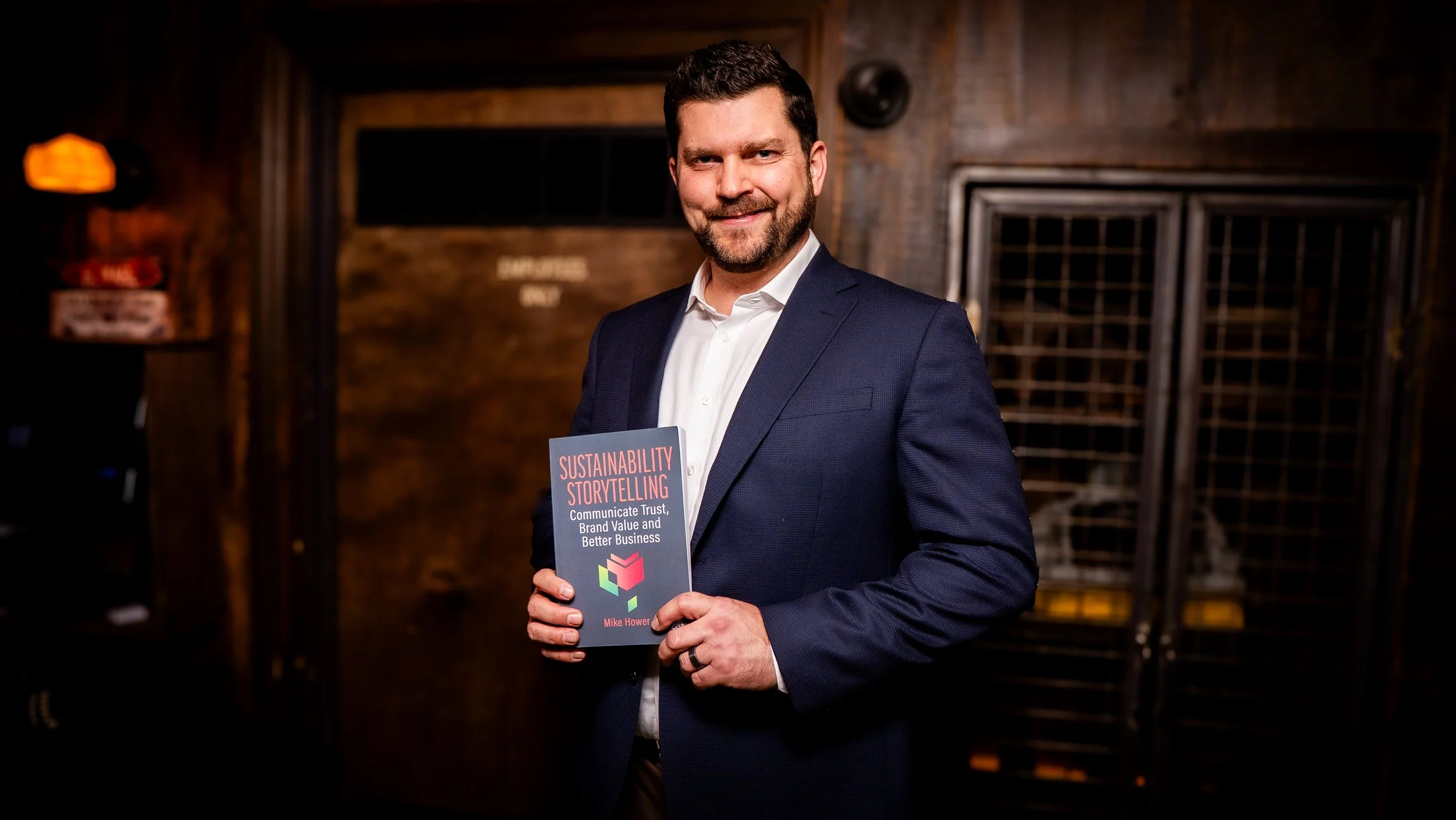
I began writing Sustainability Storytelling about a month into the Second Trump Administration, as decades of environmental and social progress began rapidly unraveling.
Corporate America’s muted response forced many sustainability professionals—including me—to confront an uncomfortable question: was sustainable business truly becoming embedded in corporate strategy, or had much of it always been a PR play?
That question haunted me. But it also clarified my purpose as an author. If companies with genuine sustainability commitments were going quiet out of fear, they needed better tools and more courage to keep telling their stories.
Today, I’m proud to share that Sustainability Storytelling: Communicate Trust, Brand Value and Better Business (Kogan Page, 2026) is now fully available in the United States and globally.
Bringing this book into the world has been one of the most challenging and meaningful projects of my career. Writing is solitary work filled with late nights and early mornings—but books are never created alone. I’m deeply grateful to the editors, beta readers, sustainability leaders, and practitioners who helped shape the ideas inside these pages.
As publication approached, I realized I didn’t want to do a conventional book launch. The moment felt too consequential for that.
Instead, I wanted to create space for honest conversations about the silence spreading across corporate sustainability—and what it will take to break it.
So Sustainability Storytelling LIVE was born.
Over two weeks, we hosted one global virtual event and three in-person gatherings in New York, Washington, D.C., and San Francisco—all somehow executed one month before my wife’s due date. What could go wrong?
Fortunately, our baby girl stayed put—but the sustainability community didn’t.
Across the four events, we brought together nearly 500 sustainability, communications, legal, and corporate affairs professionals spanning finance, technology, consumer packaged goods, beauty, and beyond. Leaders including Joel Makower of Trellis, Dave Stangis of Apollo Global Management, Ellen Jackowski of Mastercard, Erik Hansen of Workday, Kati Kallins of Adobe, and many others joined us for candid conversations about the future of sustainability communication.”
And across every city, several themes emerged.
1. Silence is becoming the default strategy
One of the clearest patterns across the events was the growing normalization of corporate silence around sustainability.
During the virtual event, I argued that silence is ultimately a losing strategy:
“When companies don’t talk about sustainability, they give the stage to the bad players.”
The stakes are growing. A 2025 GlobeScan survey found that the percentage of consumers who recalled seeing sustainability communications from brands dropped from 50 percent in 2022 to 36 percent in 2025, while trust in those communications also declined significantly.
At the same time, many organizations are retreating from public sustainability commitments amid political backlash, legal scrutiny, and growing fear of greenwashing accusations.
But throughout the tour, one point became increasingly clear: saying nothing carries reputational risks of its own.
As Patrick Flynn of Switchboard observed during our San Francisco event, many companies responded forcefully when the U.S. first withdrew from the Paris Agreement years ago. Today, faced with simultaneous political and cultural pressures, many organizations appear paralyzed about how to respond at all.
His advice: identify the sustainability issues most material to your company and stand firmly behind them rather than retreating into total silence.
2. Motivation, not information, is the problem
Another recurring theme: companies are producing more sustainability information than ever, yet struggling to make stakeholders actually care.
As I said during the virtual session:
“The problem isn’t informational. We have more sustainability data than ever. The problem is motivational.”
That idea reverberated through many conversations throughout the tour.
Joel Makower captured it well when he noted that sustainability resonates most when people experience it as something concretely better—better products, better communities, better value, better resilience—not simply as ESG terminology or technical disclosures.
Dave Stangis reinforced the importance of audience-first thinking. Too often, companies approach sustainability communication by asking what they want to say rather than what stakeholders actually need to hear.
Different audiences require fundamentally different narratives:
Investors look for long-term resilience and risk management
Employees look for purpose and credibility
Customers want authenticity without overwhelming complexity
Regulators expect evidence and accountability
Treating sustainability storytelling as one message delivered uniformly to everyone remains one of the field’s most common mistakes.
3. Trust increasingly depends on alignment
At our New York event, Alison Taylor of NYU Stern emphasized that sustainability communication can no longer function as a layer placed on top of corporate strategy.
Stakeholders increasingly expect alignment between what companies say publicly and how they operate politically, financially, and organizationally behind the scenes.
That includes:
governance structures
lobbying activities
trade association memberships
political spending
operational decision-making
Jennifer Allyn of ClimateVoice pushed this conversation further, arguing that corporate silence on climate policy isn’t neutral when companies continue funding trade groups lobbying against the very policies their sustainability strategies depend upon.
Organizations can no longer separate sustainability storytelling from institutional behavior. Stakeholders increasingly evaluate both together.
4. Radical transparency builds credibility
The Washington, D.C. conversation focused heavily on a tension many companies still struggle with: whether admitting failure damages trust.
Dan Strechay of PepsiCo offered a compelling counterexample.
When PepsiCo realized it would miss several climate, packaging, and agriculture goals—due largely to infrastructure and policy barriers—the company chose not to quietly obscure the setbacks. Instead, it communicated them directly and transparently.
According to Dan, stakeholder response was overwhelmingly positive.
That lesson matters far beyond PepsiCo.
Today’s political climate has created an easy opportunity for organizations to quietly scale back commitments without explanation. But the companies most likely to preserve credibility through this era may ultimately be the ones willing to openly discuss where they fell short, why it happened, and what comes next.
As Dan put it during our discussion, sustainability communication is ultimately just business communication. When organizations treat it with the same rigor and transparency, trust strengthens.
5. Legal scrutiny sharpens sustainability storytelling
One of the strongest conversations of the tour came from the legal perspective.
In San Francisco, Jayni Hein of Covington & Burling challenged the assumption that legal review inherently weakens sustainability communication.
Her argument was refreshingly straightforward: rigorous legal oversight doesn’t prevent strong storytelling—it improves accuracy, discipline, and credibility.
The companies best positioned to communicate confidently in today’s environment are increasingly the ones that:
involve legal teams early
establish robust verification processes
substantiate claims carefully
treat sustainability disclosures with the same seriousness as financial reporting
In other words: compliant and compelling storytelling aren’t opposing forces. The strongest sustainability narratives increasingly require both.
Why I wrote this book
These conversations reinforced something I’ve come to believe deeply: sustainability doesn’t just need better strategies. It needs better stories.
Not stories that exaggerate progress or convolute. But stories grounded in evidence, transparency, and business reality—albeit compelling enough to move people to care and act. That’s what I wrote Sustainability Storytelling to help organizations do.
The book introduces what I call the Four C’s of Effective Sustainability Storytelling:
Context: Understanding the cultural, political, and reputational forces shaping how messages are received. Read the Substack deep dive here.
Compelling: Making sustainability tangible, memorable, and emotionally resonant. Read my Substack deep dive here.
Credible: Aligning communication with operational reality. Read my Substack deep dive here.
Compliant: Reducing greenwashing risk without sacrificing clarity or impact. Read the Substack deep dive here.
The book draws on nearly two decades of experience across journalism and corporate sustainability communication, including work with GreenBiz, Sustainable Brands, TriplePundit, The North Face, HP, and Mars. It also includes conversations with leaders from PepsiCo, Salesforce, SAP, MetLife, Kenvue, Veolia, Apollo Global Management, and many others navigating these tensions in real time.
As I write in the book’s conclusion:
“The pen is in our hand. We must respect its power. Now let’s go write what happens next.”
Sustainability needs better stories. I hope this book helps people tell them.